Imagine making every decision unshaken by fear, temptation, or doubt—this is the power of Stoic decision making. How is possible that an ancient philosophy can help you transform how you approach choices? I could doubt it as well, but I see its impact on my life. Stoicism, a powerful philosophical approach developed over 2,000 years ago, offers a revolutionary framework for decision making that remains incredibly relevant today!
Can you stay calm and composed in stressful situations, handling them rationally instead of reacting emotionally or impulsively? It’s definitely not easy. But the Dichotomy of Control teaches us that we always have a choice in how we respond. It all starts with understanding what we can control and what we can’t. Mastering this Stoic mindset can dramatically boost your mental resilience and overall sense of fulfillment. In the following paragraphs, I’ll explain how you can apply this powerful approach in your life.
The Core Principles of Stoic Decision Making
1. The Dichotomy of Control
At the heart of Stoic decision making lies a fundamental principle: distinguishing between what we can and cannot control. The Stoic philosophers, particularly Epictetus, emphasized this concept through what is now known as the Dichotomy of Control.
Key aspects include:
- Focusing energy on things within your direct influence
- Accepting and releasing attachment to external circumstances
- Recognizing that your thoughts, judgments, and actions are the only true things you can control
- Avoiding emotional distress over uncontrollable events
2. Rational Emotional Processing
Stoicism doesn’t advocate for suppressing emotions, but for processing them rationally:
- Acknowledge emotions without being controlled by them
- Pause and analyze emotional responses objectively
- Separate facts from emotional interpretations
- Use reason as a tool to understand and navigate emotional experiences
3. Objective Reality Assessment
Stoics prioritize seeing things as they are, not as they wish them to be:
- Practice radical honesty with yourself
- Eliminate cognitive biases that distort perception
- View situations from multiple perspectives
- Seek truth over comfort or ego preservation
4. Virtue as the Highest Good
Decision making in Stoicism is fundamentally aligned with virtuous principles:
- Prioritize ethical considerations in choices
- Develop wisdom, courage, justice, and self-control
- Make decisions that align with your core values
- Understand that character matters more than outcomes
5. Negative Visualization (Premeditatio Malorum)
A unique Stoic technique for decision making:
- Mentally rehearse potentially challenging scenarios
- Prepare mentally for possible adverse outcomes
- Reduce anxiety by confronting potential difficulties
- Develop mental resilience and adaptability
6. Acceptance and Amor Fati
Embracing life’s circumstances with a profound acceptance:
- Accept what cannot be changed
- Find opportunity in challenges
- Develop a mindset of “loving one’s fate”
- Transform obstacles into opportunities for growth
Here's an example
Imagine you’re facing a difficult career decision. A Stoic approach would involve:
- Identifying what you can actually control (your effort, skills, attitude)
- Rationally assessing the situation without emotional bias
- Considering the most virtuous course of action
- Preparing mentally for potential challenges
- Making a decision aligned with your core values
- Accepting the outcome, whatever it may be
Modern Relevance
These principles are incredibly applicable in today’s complex world. They offer a framework for:
- Reducing decision-making anxiety
- Improving emotional intelligence
- Building personal resilience
- Maintaining integrity under pressure
Challenges in Implementation
While powerful, Stoic decision making isn’t without challenges:
- Requires consistent mental discipline
- Goes against natural emotional impulses
- Takes practice to master
- Demands ongoing self-reflection and personal growth
Recommended Practices
- Daily journaling
- Meditation
- Regular self-reflection
- Reading Stoic philosophy
- Practicing mindfulness
Practical Techniques for Stoic Decision Making
The Premeditation of Adversity (Premeditatio Malorum)
Core Concept – Mentally rehearsing potential challenges before they occur to build mental resilience and preparedness.
Practical Implementation:
- Visualize worst-case scenarios in detail
- Mentally walk through potential obstacles
- Develop contingency plans
- Reduce anxiety by familiarizing yourself with potential difficulties
Step-by-Step Process:
- Choose a potentially challenging situation
- Vividly imagine the scenario in detail
- Visualize your most rational, virtuous response
- Identify potential emotional triggers
- Develop a calm, measured action plan
Example: Imagine losing your job.
Mentally prepare by:
- Visualizing the initial emotional shock
- Planning immediate financial steps
- Considering skill development opportunities
- Maintaining emotional composure
- Viewing the challenge as a potential growth opportunity
The Dichotomy of Control Worksheet
Purpose: Clarify what you can and cannot control in a given situation.
Worksheet Structure:
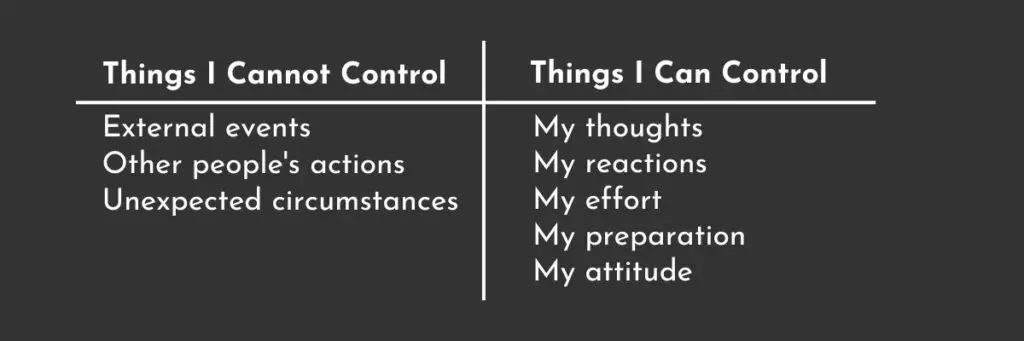
Decision-Making Process:
- Draw the two-column worksheet
- List out all elements of the situation
- Categorize each element
- Focus energy exclusively on the “can control” column
- Accept the “cannot control” column without emotional attachment
The Stoic Decision-Making Framework
Pause and Detach
- Create mental space between stimulus and response
- Take a deep breath
- Temporarily suspend emotional reaction
Gather Objective Information
- Collect facts without emotional interpretation
- Seek multiple perspectives
- Avoid confirmation bias
Align with Virtues
Evaluate decision against core virtues:
- Wisdom
- Courage
- Justice
- Temperance
Rational Analysis
- Pros and cons list
- Long-term consequences
- Alignment with personal goals
- Potential impact on character
Potential Outcome Visualization
- Mentally simulate different decision outcomes
- Prepare for various scenarios
- Develop emotional resilience
Journaling Techniques for Decision Making
Decision Journal Format
- Current Situation
- Emotional State
- Available Options
- Potential Consequences
- Virtuous Considerations
- Selected Decision
- Reflection Post-Decision
Reflection Questions
- What would my ideal self do?
- Am I acting from fear or courage?
- Does this decision align with my core values?
- What can I learn regardless of the outcome?
Emotional Regulation Techniques
Box Breathing
- Inhale for 4 counts
- Hold for 4 counts
- Exhale for 4 counts
- Hold for 4 counts

Cognitive Reframing
- Identify negative thought patterns
- Challenge irrational beliefs
- Reframe challenges as opportunities
Delayed Reaction Protocol
- Implement a mandatory waiting period before major decisions
- Minimum 24-hour reflection for significant choices
- Prevents impulsive decisions
Negative Visualization Exercise
Daily Practice:
- Spend 5-10 minutes imagining potential challenges
Mentally prepare for:
- Professional setbacks
- Personal relationship challenges
- Health uncertainties
- Financial difficulties
Benefits:
- Reduces anxiety
- Increases adaptability
- Builds mental resilience
- Provides perspective
External Perspective Technique
Methods:
- Imagine advising a friend
- Consult a trusted mentor
- Write from a third-person perspective
- Consider how a respected historical figure might approach the decision
Continuous Learning Approach
Decision Review Process:
- Document decisions and outcomes
- Regularly review past choices
- Identify patterns
- Adjust decision-making approach
- Celebrate growth and learning
Technology Tools:
- Decision-making apps
- Journaling platforms
- Meditation and mindfulness apps
- Habit tracking software
Potential Challenges:
- Maintaining consistency
- Overcoming ingrained emotional patterns
- Developing patience
- Avoiding over-analysis
Key Reminders:
- Progress over perfection
- Compassion towards self
- Continuous learning
- Embrace uncertainty
Stoic decision making is a skill. Like any skill, it improves with intentional, consistent practice. Be patient with yourself, remain curious, and focus on gradual improvement!